Skip to content
  • Categories
  • Recent
  • Tags
  • Popular
  • Users
  • Groups
Skins
  • Light
  • Brite
  • Cerulean
  • Cosmo
  • Flatly
  • Journal
  • Litera
  • Lumen
  • Lux
  • Materia
  • Minty
  • Morph
  • Pulse
  • Sandstone
  • Simplex
  • Sketchy
  • Spacelab
  • United
  • Yeti
  • Zephyr
  • Dark
  • Cyborg
  • Darkly
  • Quartz
  • Slate
  • Solar
  • Superhero
  • Vapor

  • Default (No Skin)
  • No Skin
Collapse

The New Coffee Room

  1. TNCR
  2. General Discussion
  3. Puzzle time - the Fibonacci numbers

Puzzle time - the Fibonacci numbers

Scheduled Pinned Locked Moved General Discussion
31 Posts 4 Posters 382 Views
  • Oldest to Newest
  • Newest to Oldest
  • Most Votes
Reply
  • Reply as topic
Log in to reply
This topic has been deleted. Only users with topic management privileges can see it.
  • jon-nycJ Offline
    jon-nycJ Offline
    jon-nyc
    wrote on last edited by
    #13

    What language is that?

    The whole reason we call them illegal aliens is because they’re subject to our laws.

    KlausK 1 Reply Last reply
    • HoraceH Offline
      HoraceH Offline
      Horace
      wrote on last edited by
      #14

      It's a computer language. Computer programmers use computer languages to "talk" to computers and tell them what to do!

      Education is extremely important.

      1 Reply Last reply
      • jon-nycJ Offline
        jon-nycJ Offline
        jon-nyc
        wrote on last edited by
        #15

        Interesting observation:

        Cycle lengths 2^n = 3*2^(n-1) at least within the first 100. Does that continue?

        The whole reason we call them illegal aliens is because they’re subject to our laws.

        jon-nycJ 1 Reply Last reply
        • jon-nycJ jon-nyc

          What language is that?

          KlausK Offline
          KlausK Offline
          Klaus
          wrote on last edited by Klaus
          #16

          @jon-nyc said in Puzzle time - the Fibonacci numbers:

          What language is that?

          Haskell.

          I bet if you do the same thing in your favorite language you need at least twice as much code, and the code will be less extensible. (throws gauntlet)

          1 Reply Last reply
          • jon-nycJ Offline
            jon-nycJ Offline
            jon-nyc
            wrote on last edited by
            #17

            I use 8086 assembler for such tasks.

            The whole reason we call them illegal aliens is because they’re subject to our laws.

            1 Reply Last reply
            • Doctor PhibesD Offline
              Doctor PhibesD Offline
              Doctor Phibes
              wrote on last edited by
              #18

              Are you two about to have a 'my dick is smaller' contest?

              I was only joking

              KlausK 1 Reply Last reply
              • Doctor PhibesD Doctor Phibes

                Are you two about to have a 'my dick is smaller' contest?

                KlausK Offline
                KlausK Offline
                Klaus
                wrote on last edited by
                #19

                @Doctor-Phibes Did you know that dick sizes have a Fibonacci distribution? It's a distribution with a very long tail...

                <insert @George-K rimshot image macro here>

                1 Reply Last reply
                • jon-nycJ jon-nyc

                  Interesting observation:

                  Cycle lengths 2^n = 3*2^(n-1) at least within the first 100. Does that continue?

                  jon-nycJ Offline
                  jon-nycJ Offline
                  jon-nyc
                  wrote on last edited by
                  #20

                  @jon-nyc said in Puzzle time - the Fibonacci numbers:

                  Interesting observation:

                  Cycle lengths 2^n = 3*2^(n-1) at least within the first 100. Does that continue?

                  bump for Klaus and his little 4 line program.

                  The whole reason we call them illegal aliens is because they’re subject to our laws.

                  KlausK 1 Reply Last reply
                  • jon-nycJ jon-nyc

                    @jon-nyc said in Puzzle time - the Fibonacci numbers:

                    Interesting observation:

                    Cycle lengths 2^n = 3*2^(n-1) at least within the first 100. Does that continue?

                    bump for Klaus and his little 4 line program.

                    KlausK Offline
                    KlausK Offline
                    Klaus
                    wrote on last edited by Klaus
                    #21

                    @jon-nyc said in Puzzle time - the Fibonacci numbers:

                    @jon-nyc said in Puzzle time - the Fibonacci numbers:

                    Interesting observation:

                    Cycle lengths 2^n = 3*2^(n-1) at least within the first 100. Does that continue?

                    bump for Klaus and his little 4 line program.

                    Can you explain? You mean that the cycle length of Fib mod (2^n) is the same as Fib mod (3*2^(n-1))? That doesn't seem to be true.

                    I uploaded the first 10,000 cycle lengths here, if you want to check this yourself.
                    https://www.heypasteit.com/clip/0IV18W

                    1 Reply Last reply
                    • jon-nycJ Offline
                      jon-nycJ Offline
                      jon-nyc
                      wrote on last edited by jon-nyc
                      #22

                      No, the cycle length of Fib mod (2^n) = 3*2^(n-1))

                      Check Fmod2, Fmod4, Fmod8, Fmod16 etc for their cycle lengths. You’ll get 3,6,12,24,48 etc. I’m wondering if it holds. I think it will.

                      The whole reason we call them illegal aliens is because they’re subject to our laws.

                      1 Reply Last reply
                      • KlausK Offline
                        KlausK Offline
                        Klaus
                        wrote on last edited by
                        #23

                        Here's a list of pairs where the first number shows the "n" (but only for powers of 2) and the second one the associated cycle length. Maybe I missunderstood something but your conjecture doesn't seem to hold.

                        [(2,6),(4,24),(8,60),(16,24),(32,36),(64,120),(128,420),(256,264),(512,516),(1024,72),(2048,600),(4096,1368),(8192,720)]
                        
                        1 Reply Last reply
                        • jon-nycJ Offline
                          jon-nycJ Offline
                          jon-nyc
                          wrote on last edited by jon-nyc
                          #24

                          But your original list is this one:

                          (left side numbering mine, right side list yours)

                          3e9774ed-e059-4cd4-956f-c8646a08d27b-image.png

                          The whole reason we call them illegal aliens is because they’re subject to our laws.

                          1 Reply Last reply
                          • KlausK Offline
                            KlausK Offline
                            Klaus
                            wrote on last edited by
                            #25

                            Ah, looks like an "off by two" error somewhere. Hmm....

                            1 Reply Last reply
                            • KlausK Offline
                              KlausK Offline
                              Klaus
                              wrote on last edited by Klaus
                              #26

                              Turned out to be two "off by 1" errors that have to do with indices starting at 0 and not 1.

                              What about this result?

                              [(2,3),(4,6),(8,12),(16,24),(32,48),(64,96),(128,192),(256,384),(512,768),(1024,1536),(2048,3072),(4096,6144),(8192,12288)]
                              
                              1 Reply Last reply
                              • KlausK Offline
                                KlausK Offline
                                Klaus
                                wrote on last edited by Klaus
                                #27

                                It looks like linear relations between the cycle length happen quite frequently. This is a scatter plot of the cycle lengths I computed above (haven't used R in a while - fun for plotting data!). Observe all the dotted lines. The points you identified are on one of those lines. Also interesting to see a few outliers.
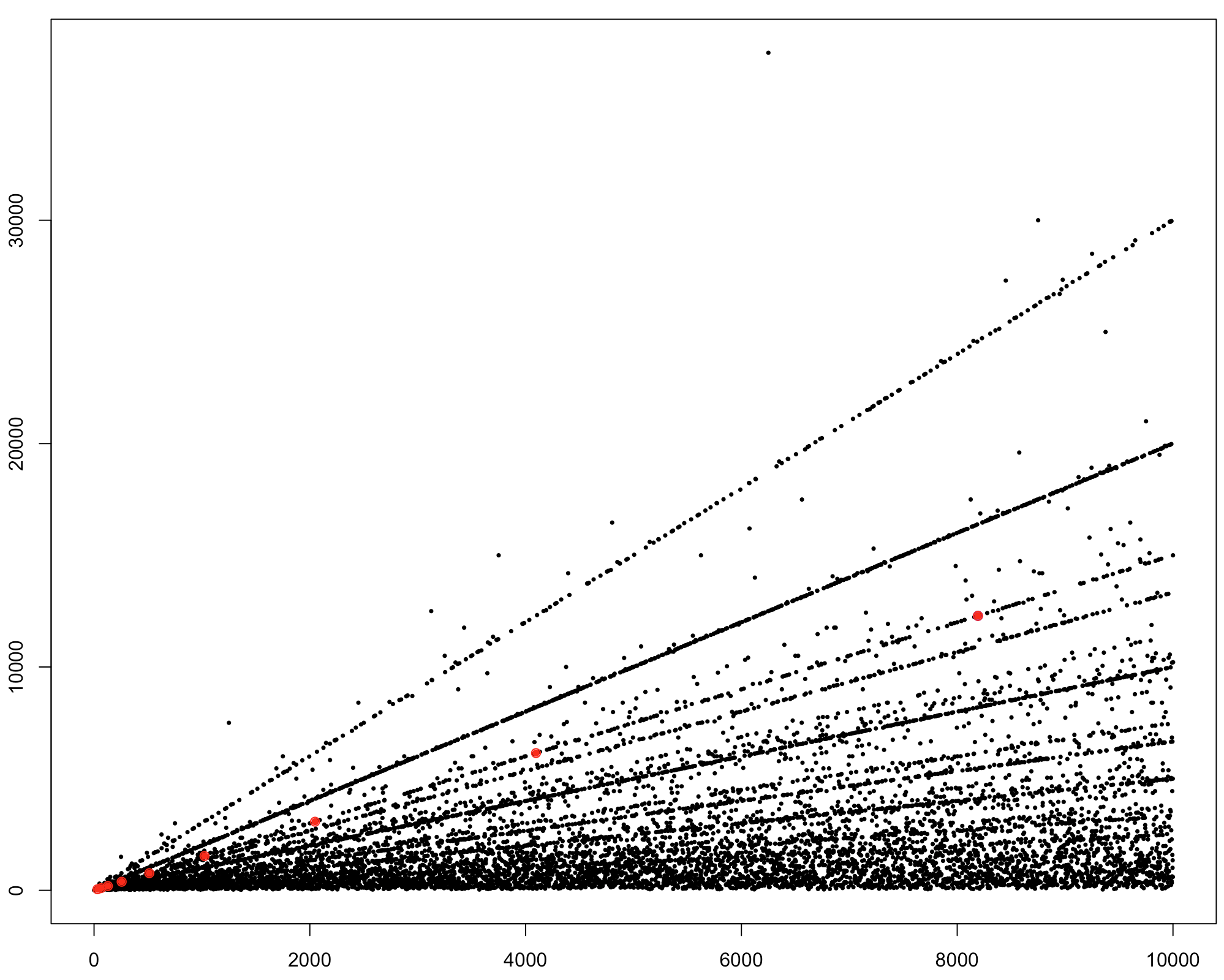
                                440d6f5b-c0a6-4d2d-b301-7d3d66c1fafd-image.png

                                I have marked the points you are interested in in red. You see that there are way more points on that line.

                                1 Reply Last reply
                                • jon-nycJ Offline
                                  jon-nycJ Offline
                                  jon-nyc
                                  wrote on last edited by
                                  #28

                                  Interesting.

                                  So it turns out Fibonacci cycle lengths a thing people study. They’re called Pisano numbers and understanding them is really about understanding Pisano numbers for prime powers.

                                  A neat property is that if n and m are coprime then period(mn) is least common multiple of period(n) and period(m).


                                  The whole reason we call them illegal aliens is because they’re subject to our laws.

                                  1 Reply Last reply
                                  • jon-nycJ Offline
                                    jon-nycJ Offline
                                    jon-nyc
                                    wrote on last edited by
                                    #29

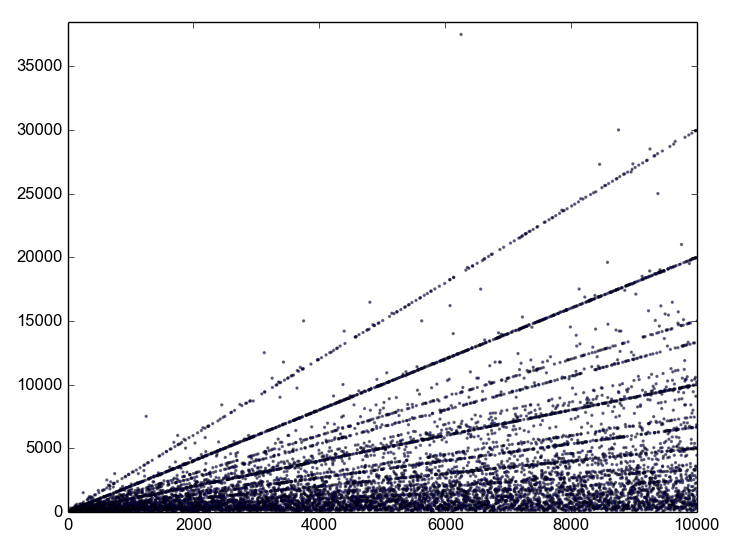
                                    Wait a minute, is that really your graph up there? This is from Wiki

                                    396851CA-71EE-4E8B-AB14-42964B4121AC.png

                                    The whole reason we call them illegal aliens is because they’re subject to our laws.

                                    1 Reply Last reply
                                    • KlausK Offline
                                      KlausK Offline
                                      Klaus
                                      wrote on last edited by Klaus
                                      #30

                                      Yes, it's my graph. I haven't seen the WIki graph yet, but it shows the same data, so of course it's similar. It's an interesting coincidence that they also cut off at 10,000.

                                      1 Reply Last reply
                                      • KlausK Offline
                                        KlausK Offline
                                        Klaus
                                        wrote on last edited by
                                        #31

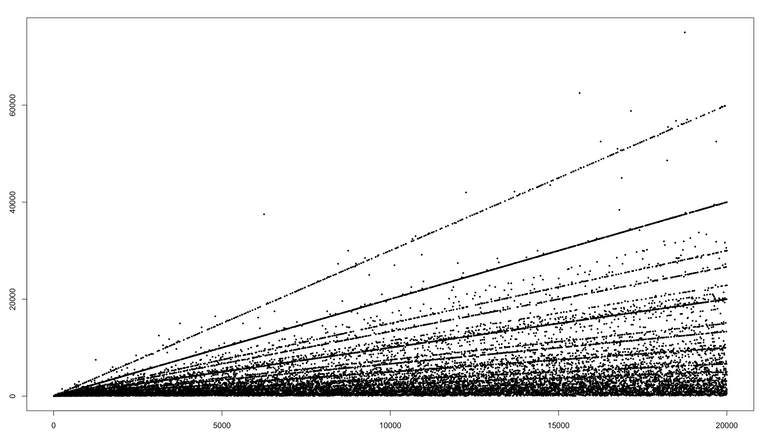
                                        Just for fun, here's the continuation of the dataset for cycle lengths up to 20000.

                                        1549ea7c-ea85-4eca-aea0-3b73c980f9aa-image.png

                                        1 Reply Last reply

                                        Hello! It looks like you're interested in this conversation, but you don't have an account yet.

                                        Getting fed up of having to scroll through the same posts each visit? When you register for an account, you'll always come back to exactly where you were before, and choose to be notified of new replies (either via email, or push notification). You'll also be able to save bookmarks and upvote posts to show your appreciation to other community members.

                                        With your input, this post could be even better 💗

                                        Register Login
                                        Reply
                                        • Reply as topic
                                        Log in to reply
                                        • Oldest to Newest
                                        • Newest to Oldest
                                        • Most Votes


                                        • Login

                                        • Don't have an account? Register

                                        • Login or register to search.
                                        • First post
                                          Last post
                                        0
                                        • Categories
                                        • Recent
                                        • Tags
                                        • Popular
                                        • Users
                                        • Groups