Mildly interesting
-

When rescuers first found Beauty, a bald eagle in Alaska, she was barely alive. A single gunshot had destroyed her upper beak, the tool she needed for everything: eating, drinking, grooming, and defending herself. Without it, she was trapped in a slow, inevitable decline. In the wild, she would have survived only a few days.
But a handful of strangers refused to accept that ending.
A wildlife rehabilitator contacted a mechanical engineer. The engineer brought in a dentist. A dentist reached out to a 3D-printing specialist. Piece by piece, a small, unlikely team formed around a single goal: to give a wounded eagle a second chance at life.
They spent months studying Beauty’s injuries, scanning her skull, designing prototypes, and testing materials that were both light enough for flight and strong enough for daily use. Every millimeter mattered. The prosthetic had to match the shape of a beak that no longer existed.
When the final 3D-printed beak was ready, the team attached it with careful precision.
Then, in a room full of people holding their breath, Beauty did something miraculous.
She reached down…
gripped a piece of food…
and fed herself for the first time since the gunshot.Some cried. Others laughed in disbelief. All of them knew they had witnessed a turning point — not just for one eagle, but for the future of wildlife rehabilitation.
Over the following months, another surprise emerged. Protected by the prosthetic, Beauty’s natural beak began to regrow underneath it. The device had not only restored her function — it had given her body the chance to heal.
Beauty became the first bald eagle in history to receive a fully functional, 3D-printed beak.
Her story remains a powerful reminder that when compassion and innovation work together, even the most broken lives can be rebuilt.If one eagle can inspire this level of devotion… imagine what could happen if we offered the same determination to every living being. See less
-

In 564 BC, a Greek fighter won Olympic gold—after he was already dead.
Arrichion of Phigalia was one of ancient Greece’s greatest athletes, a three-time Olympic champion in pankration, the most savage event of the Games. Pankration blended wrestling, boxing, joint-locks, and chokes into a contest with almost no rules—no rounds, no time limits, and no mercy. Victory came only when one fighter submitted or was rendered unable to continue. By the time Arrichion entered the 54th Olympiad, he was already a legend, feared for his endurance and brutal technique. But his final match would push him beyond the limits of human survival.
During the bout, Arrichion’s opponent managed to wrap an arm around his throat and lock his legs around Arrichion’s torso, applying a choke so tight that he began to lose consciousness. Spectators watched as the champion’s body trembled on the sand, his vision fading, his breath slipping away. Yet even as death crept in, Arrichion refused to tap. In a final, desperate motion, he twisted violently and wrenched his opponent’s toe out of its joint. The pain was so blinding that his opponent screamed and signaled surrender. In that same moment, Arrichion went limp—already dead from suffocation.
What followed was unlike anything in Olympic history. Judges declared Arrichion the winner because his opponent had submitted first. His lifeless body was crowned with the olive wreath, carried out of the arena to thunderous celebration. To the Greeks, this wasn’t tragedy but triumph: the ultimate proof of courage, endurance, and devotion to glory. Arrichion became immortal not only as a champion, but as the only athlete ever to win the Olympics from beyond the grave—a testament to a culture that believed true honor was worth any price, even life itself.
-
wrong python character.
more like this guy
-

The hole in the roof isn't a mistake. It is the only reason the building is still standing.
When people walk into the Pantheon, they look up at the rain falling through the 9-meter opening and ask: "Did they run out of money? Why didn't they finish the roof?"
The answer is Roman genius.- Why is the hole there? (The Engineering) If the Romans had closed the dome with heavy concrete, the weight at the top would have been too crushing. The dome would have collapsed under its own stress 2,000 years ago. The Oculus (the eye) acts as a "Reverse Keystone." It actually relieves the structural tension. It lightens the load at the weakest point of the dome.
- The Secret Recipe (Why it doesn't collapse) The Romans didn't just pour one type of concrete. They were the masters of chemistry.
At the bottom (the base): They used concrete mixed with heavy Travertine rock for strength.
In the middle: They switched to lighter Tuff rock.
At the very top (near the hole): They mixed the concrete with Pumice (volcanic rock so light it floats on water).
The top of the dome is incredibly light. If they had used the heavy bottom concrete at the top, the Pantheon would be a pile of rubble today. - Why doesn't it flood? It has rained inside the Pantheon for nearly 2,000 years. So why isn't the floor a swimming pool? If you look closely at the marble floor, it isn't flat. It is slightly convex (curved in the center). This guides the rainwater toward 22 tiny, hidden drainage holes cut directly into the marble. The water flows into an ancient Roman sewer system underneath the building—a system that still works today.
- The "Sun" Dial The hole wasn't just for weight; it was for the gods. The Pantheon was a temple to "All Gods." The Oculus allowed the heavens to enter the temple. On April 21st (the birthday of Rome), the sun strikes the entrance grill perfectly at noon. It wasn't just a building; it was a functioning astronomical clock.
So no, they didn't forget the glass. They built a machine made of stone that has survived Barbarians, Popes, and gravity for 19 centuries.
"You cannot subsidize irresponsibility and expect people to become more responsible." — Thomas Sowell
-
-
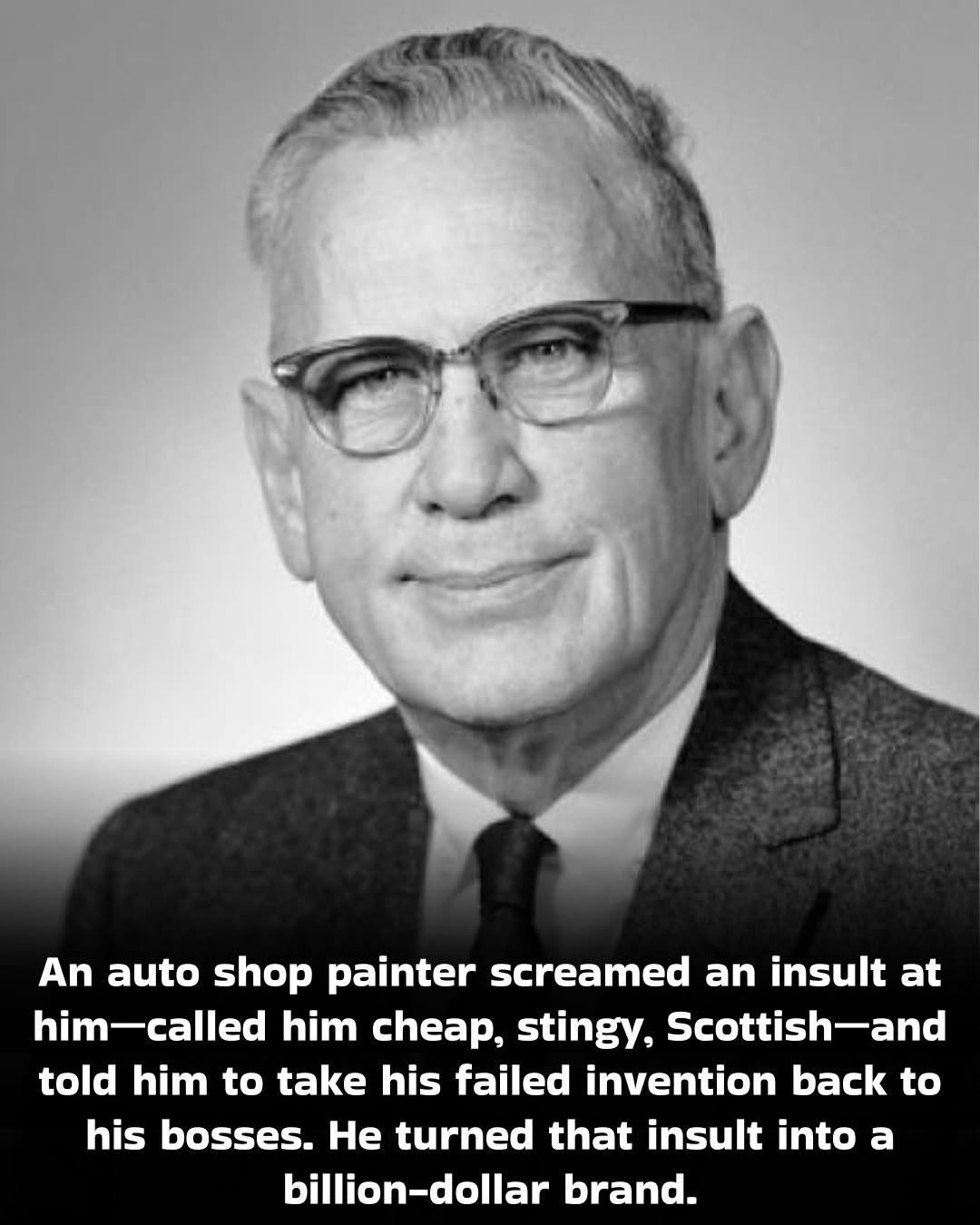
An auto shop painter screamed an insult at him—called him cheap, stingy, Scottish—and told him to take his failed invention back to his bosses. He turned that insult into a billion-dollar brand.
St. Paul, Minnesota, 1923.
Richard Drew walked into an auto body shop carrying samples of sandpaper. He was 24 years old, worked in the testing lab at Minnesota Mining and Manufacturing Company—a small sandpaper manufacturer that would later become 3M.
He was supposed to drop off the samples and leave.
But he heard swearing. Loud, creative, furious swearing.
He looked over and saw what was making the painters so angry.
They were attempting the newest trend in automotive fashion: two-tone paint jobs. Gorgeous when done right—a sharp, clean line between two contrasting colors that made a car look expensive and modern.
The problem was that creating that clean line was nearly impossible.
The process worked like this: Paint the car one color. Wait for it to dry. Cover that section with heavy butcher paper or surgical tape. Paint the second color. Remove the paper and reveal a perfect dividing line.
That was the theory.
In practice, it was a disaster.
The adhesives available in 1923 were far too aggressive. They were designed to stick and stay stuck. When painters peeled off the masking paper, it often ripped the fresh paint right off with it.
Hours of painstaking work destroyed in seconds.
Drew watched them try multiple times. Same result. The paint came off in strips, leaving bare metal underneath. They'd have to sand it down and start over.
One painter looked ready to throw his tools through a window.
Drew wasn't a chemist. He wasn't an engineer. He'd dropped out of the University of Minnesota after one year because he couldn't afford tuition. He played banjo in his spare time and worked in a sandpaper lab because it paid the bills.
But he looked at those frustrated painters and made a promise that would change his life.
"I think I can fix this."
The painters stared at him. Who was this sandpaper delivery kid claiming he could solve a problem that was stumping professional adhesive manufacturers?
Drew didn't care. He went back to 3M's lab and started experimenting.
His boss wasn't thrilled. Drew was supposed to be testing sandpaper quality, not inventing new products. But Drew worked on it anyway—during breaks, after hours, whenever he could steal lab time.
He tried everything. Vegetable oils. Various resins. Natural rubber. Glycerin. He was searching for the impossible: an adhesive strong enough to stay in place during painting but gentle enough to remove without damage.
It was a chemistry puzzle that didn't want to be solved.
For two years, he failed. Over and over and over.
He'd create a prototype, test it, watch it fail. Too weak—the tape fell off during painting. Too strong—it ripped the paint off. Too thick—it left residue. Too thin—it didn't seal properly.
His boss told him to stop wasting time and get back to sandpaper testing.
Drew ignored him.
Finally, in 1925, he thought he had it. A crepe paper backing coated with a rubber-based adhesive he'd formulated through countless iterations. It stuck firmly but could be removed cleanly.
He was confident. This was going to work.
He returned to the auto shop and applied his prototype tape to a freshly painted car. The painters watched skeptically. They'd seen plenty of "solutions" that failed.
Drew told them to go ahead—apply the second color.
They painted over the tape. So far, so good. The tape stayed in place.
Now came the crucial moment. The painter grabbed the edge of the tape and pulled.
The tape fell off in his hands.
It hadn't even waited for him to peel it. It just dropped off, leaving the paint underneath smeared and ruined.
The problem was immediately obvious. To save money on adhesive—which was expensive—Drew had only coated the edges of the tape, leaving the middle section bare.
It was a cost-cutting measure. A practical decision from someone working in a sandpaper company's lab without unlimited budget.
It was also a stupid mistake.
The painter looked at the failed tape. Looked at Drew. Looked at the ruined paint job.
And he exploded.
"Take this tape back to those Scotch bosses of yours," he shouted, "and tell them to put more adhesive on it!"
"Scotch" wasn't a reference to Scotland. It was 1920s slang for "stingy" or "cheap." He was saying Drew's employers were too cheap to coat the whole tape properly.
It was an insult. A dismissal. Proof that Drew had wasted two years on something that didn't work.
Most people would have given up. Would have gone back to testing sandpaper and forgotten about the failed tape experiment.
Drew went back to the lab and coated the entire strip with adhesive.
It took another few months of refinement, but by late 1925, he had it: Scotch Masking Tape—the world's first practical masking tape for painting.
It worked perfectly. Auto body shops started ordering it in bulk. The two-tone paint job trend exploded because suddenly it was achievable. 3M had accidentally stumbled into a new business.
But Drew wasn't done.
He looked at his masking tape and thought: What if I could make this waterproof? And transparent?
By 1930, he'd figured it out. He replaced the crepe paper backing with cellophane—a new material made from regenerated cellulose—and developed a new adhesive formula that was moisture-resistant and crystal clear.
Scotch Cellophane Tape.
The timing couldn't have been better.
The Great Depression hit America like a wrecking ball. People lost jobs, lost savings, lost everything. Unemployment reached 25%. Families struggled to afford food, let alone new possessions.
In that environment, a product that could fix things instead of replacing them was gold.
Scotch Tape became America's repair kit.
People used it for everything. They mended torn pages in books so children could keep reading. They fixed cracked window shades. They patched broken toys so kids didn't know how poor the family had become. They sealed envelopes, repaired sheet music, held together worn-out shoe soles.
It was supposed to be an industrial packaging product. Instead, it became a symbol of American resilience—the ability to make do, to fix what's broken, to hold things together even when everything is falling apart.
Hardware stores couldn't keep it in stock. The transparent tape with the plaid logo—adopted from the "Scotch" nickname—became a household staple.
By 1932, 3M was selling millions of rolls annually.
The name that started as an insult—"Scotch," meaning cheap and stingy—became one of the most recognized brands in America.
Richard Drew became 3M's director of product fabrication. He held over 30 patents by the time he retired. He invented multiple other adhesive products, but none matched the cultural impact of Scotch Tape.
He died in 1980 at age 81. By then, Scotch Tape was in virtually every American home, office, and school.
All because he refused to accept that failure in the auto shop as the end of the story.
Think about what happened here. An insult became a brand name. A cost-cutting mistake led to a crucial learning moment. A side project that his boss told him to quit became a billion-dollar product line.
Drew succeeded because he did something most people don't do: he listened to the insult instead of just being hurt by it.
That painter wasn't wrong. The tape was cheap because Drew had skimped on adhesive. Instead of getting defensive, Drew fixed the actual problem. He went back and did it right.
That's harder than it sounds. When someone calls your work cheap, when they mock your effort, when they dismiss two years of experimentation as worthless—the natural response is to quit or get angry.
Drew did neither. He heard the criticism, recognized the truth in it, and solved the problem.
The other crucial element: he ignored his boss telling him to stop.
Drew was supposed to be testing sandpaper. That was his job. His supervisor told him repeatedly to stop wasting time on tape experiments. Company resources were meant for sandpaper development, not side projects.
Drew kept working on it anyway. After hours. During lunch. Whenever he could steal lab time.
If he'd been obedient, if he'd followed orders, masking tape might never have been invented—or at least not by him.
Sometimes the most important innovations come from people working on problems they're not supposed to be solving.
And then there's the "Scotch" name itself. Most companies would have rejected a brand name that originated as an insult. 3M's marketing department could have called it "3M Masking Tape" or "Professional Grade Tape" or literally anything else.
But they kept "Scotch." They owned the insult. They turned it into an asset.
Because by the 1930s, "Scotch" didn't just mean cheap—it meant economical, practical, sensible. During the Depression, those were virtues. Being Scottish wasn't an insult; it meant you were careful with money, resourceful, able to make things last.
The name that was meant to shame Drew's stinginess became associated with American thrift and ingenuity.
That painter who screamed at Drew in 1925 probably never knew he'd named one of the most successful products of the 20th century.
He thought he was delivering an insult. He was actually creating a legacy.
Richard Drew: college dropout, banjo player, sandpaper tester, inventor.
He turned a painting problem into a household necessity. He turned criticism into motivation. He turned an insult into a brand worth billions.
Every time you tear off a piece of tape to fix something broken, you're using the product a 24-year-old created because he refused to accept failure.
The next time someone calls your work cheap or stingy or not good enough—remember Richard Drew.
He heard the same thing. And then he fixed it and changed the world.
-
Lo, no accord shall bloom 'twixt us and that realm, save they do kneel in token of their utter, soul-deep shame! No parley shall we hold, no treaty sign, until their will is broken, and their strength doth lie as dust before our might. -DJT, 3/6/26
-
@jon-nyc said in Mildly interesting:
That’s a pointless and useless statistic.
-
in 1989, the 70+ crowd was the Greatest Generation, which was decimated by two wars, and higher mortality from any number of causes. Today, the 70+ crowd are the boomers, much more plentiful in numbers, so it’s only natural for a higher percentage of the wealth is in their hands.
-
in 1989, the average mortgage interest rate was/is 10.25%, so all of these people bitching about interest rates as a cause for the affordability crisis can bite me.
-
As @Mik points out, a percentage of how much?
-
I think I’m typing this post on one of the biggest reasons for the wealth gap. When I was in my 20s, I wasn’t having to buy a $1K phone every 4 years, a new computer every 4-5 years, and spending thousands of dollars on internet and data plans every year. These days it’s expected…
-




Hello! It looks like you're interested in this conversation, but you don't have an account yet.
Getting fed up of having to scroll through the same posts each visit? When you register for an account, you'll always come back to exactly where you were before, and choose to be notified of new replies (either via email, or push notification). You'll also be able to save bookmarks and upvote posts to show your appreciation to other community members.
With your input, this post could be even better 💗
Register Login