Market after NVDA
-
Here’s a concise summary:
Howard Marks (Co-Chairman of Oaktree Capital Management) issued a follow-up memo on AI, noting how rapidly the technology has advanced even in a few months. He observes that AI is increasingly moving toward autonomous systems where humans set objectives and guardrails, and the AI executes, reviews, and delivers finished work independently.
Marks believes AI is real, powerful, and likely capable of replacing substantial knowledge work. He suggests its long-term potential is more likely underestimated than overestimated. However, he cautions that this does not automatically mean AI-related investments are cheap or fairly priced.
He points out that soaring demand for AI capacity is already driving major revenue growth and validating the large capital expenditures by hyperscalers such as Microsoft, Alphabet, and Amazon. While these companies could turn out to be either overvalued or undervalued, Marks doubts they will ultimately be remembered as dramatically overpriced given their profitability.
His conclusion: since no one can definitively say whether this is a bubble, investors should avoid going “all-in” (risking ruin) or “all-out” (risking missing a major technological shift). Instead, he recommends a moderate, selective, and prudent allocation to AI.
-
If I were smart, and maybe I'll ask my TARS, is it would be better to invest in companies that are prime to gain from AI productivity, instead of which companies will be actually building the AI infrastructure, which seems far riskier given the vast sums of cash being thrown into it.
-
TARS, after some compliments about this approach basically said:
- Cybersecurity/IT: Crowdstrike and Palo Alto Networks
- Enterprise/Workforce Management: ServiceNow and Workday
- Smart building/HVAC: Johnson Controlls, Carrier Global, Lennox International
- Financial Services/Insurance: JP Morgan Chase and Progressive
-
Market continues to put its money behind a software and AI collapse today.
I might consider the government restraining AI in private business to be a risk, but due to global competition, I don't see how they can.
The biggest looming issue I see is the mass job losses.
Enterprise software sold by the seat might be affected due to that as well, I guess.
-
Did she actually say “dollars” after “the DOW is at 50,000”?
If so, I need to think about whether that’s more or less embarrassing than saying “two Corinthians.”@Axtremus said in Market after NVDA:
Did she actually say “dollars” after “the DOW is at 50,000”?
If so, I need to think about whether that’s more or less embarrassing than saying “two Corinthians.”Yep she said that, but when she repeated it, she left "dollars" out. It was a slip of the tongue that she was aware of.
It's sort of accurate anyway. The DJIA actually is a function of stock prices, which are in dollars.
-
Fun fact about the DJIA, it is an astonishingly dumb way of computing how well the market is doing. It is a function of share price of those 30 companies, rather than market cap. A company with few shares and a high stock price means more than a company with a ton of shares and a low stock price, even though the latter company might be worth much more.
-
Yeah one can search ‘shit index’ on old TNCR and see me go on about that very fact.
-
Berkshire Hathaway, which has the odd tradition of reporting on Saturday mornings, turned in a real flop. Profits down 30%. But the stock has been garbage for a while, so maybe this was priced in. It'll be interesting what it does on Monday.
I don't know how anybody justifies to themselves buying BRK when the executives of BRK, with an enormous cash pile, refuse to buy their own shares. If you believe in BRK because you think it's a wisely run business, then ironically you shouldn't be buying their stock.
-
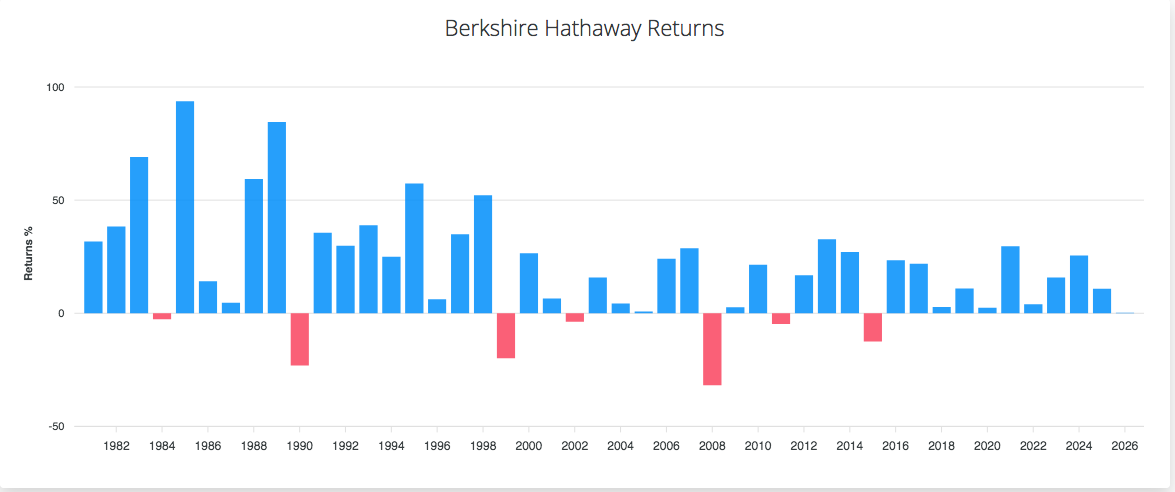
Overall, I think that the stock of Bershire Hathaway has done pretty well.






Hello! It looks like you're interested in this conversation, but you don't have an account yet.
Getting fed up of having to scroll through the same posts each visit? When you register for an account, you'll always come back to exactly where you were before, and choose to be notified of new replies (either via email, or push notification). You'll also be able to save bookmarks and upvote posts to show your appreciation to other community members.
With your input, this post could be even better 💗
Register Login