Puzzle time - odd run of heads
-
:::
You didn't specify that the solution must be analytic, so...Just for the heck of it, I thought this might be a good excuse to play around with WebPPL.
This is the distribution and expected value I got.
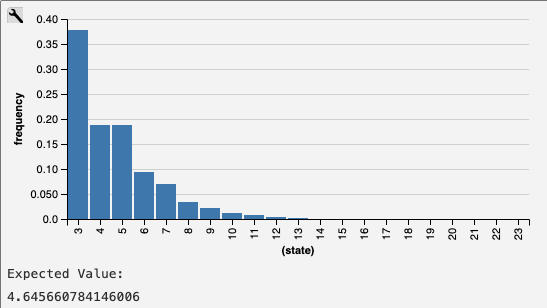
The model I used was this. You can just copy&paste it to http://webppl.org/ and play around with it, if you want to get an impression of what probabilistic programming is.
var oddrun = function() {
  var fluntil = function() {
    flip(.5) ? fluntil() + 1 : 1
  }
  var flodd = function() {
    if (flip(.5)) {
      return { success : false , l : 1}
    } else {
      var r = flodd();
      return { success : !(r.success), l : r.l+1 } ;
    }
  }
  var run = function() {
    var r = flodd()
    return r.success ? r.l : r.l + run()
  };
  var l = fluntil()
  return l + run()
}
var dist = Infer(
  {method: 'enumerate', maxExecutions: 50000},
  oddrun);

viz.auto(dist);
display("Expected Value:")
display(expectation(dist))
:::
-
:::
You didn't specify that the solution must be analytic, so...Just for the heck of it, I thought this might be a good excuse to play around with WebPPL.
This is the distribution and expected value I got.
The model I used was this. You can just copy&paste it to http://webppl.org/ and play around with it, if you want to get an impression of what probabilistic programming is.
var oddrun = function() {
  var fluntil = function() {
    flip(.5) ? fluntil() + 1 : 1
  }
  var flodd = function() {
    if (flip(.5)) {
      return { success : false , l : 1}
    } else {
      var r = flodd();
      return { success : !(r.success), l : r.l+1 } ;
    }
  }
  var run = function() {
    var r = flodd()
    return r.success ? r.l : r.l + run()
  };
  var l = fluntil()
  return l + run()
}
var dist = Infer(
  {method: 'enumerate', maxExecutions: 50000},
  oddrun);

viz.auto(dist);
display("Expected Value:")
display(expectation(dist))
:::
-
Oh right, I think there was a missing plus sign in my model, which I've now fixed.
This is what I get now.
:::
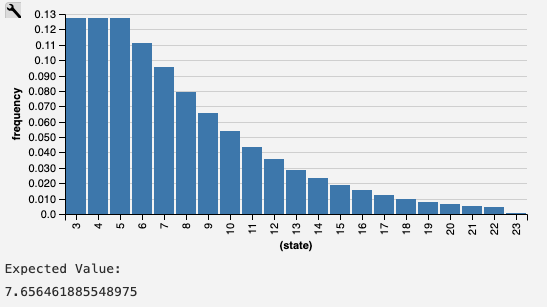
This looks right to me. The probability of THT is 1/8. The probability of TTHT or HTHT is 1/16, with a combined probability of 1/8.
My take for an analytic solution would be to count how many "winning" sequences of length n there are (let's call this q(n)) and then compute the limit of the sum of all i*q(i) / (2^i)
(for i = 1 to infinity) to get the expected value. Obviously, q(1)=0, q(2) = 0, q(3) = 1 and q(4) = 2. From the distribution diagram above I infer q(5) = 4 and q(6) = 7.This looks suspiciously similar to the Fibonacci sequence minus one.
:::
-
:::
That's the limit of the sum of all i*(Fib(i)-1) / (2^i). The main insight is that the number of "winning" sequences of length i is Fib(i)-1.
I don't really have an argument why it needs to be Fib(i)-1 (except the "abductive reasoning" rationale above), but I'm pretty confident that it is correct.
:::

Hello! It looks like you're interested in this conversation, but you don't have an account yet.
Getting fed up of having to scroll through the same posts each visit? When you register for an account, you'll always come back to exactly where you were before, and choose to be notified of new replies (either via email, or push notification). You'll also be able to save bookmarks and upvote posts to show your appreciation to other community members.
With your input, this post could be even better 💗
Register Login