Skip to content
  • Categories
  • Recent
  • Tags
  • Popular
  • Users
  • Groups
Skins
  • Light
  • Brite
  • Cerulean
  • Cosmo
  • Flatly
  • Journal
  • Litera
  • Lumen
  • Lux
  • Materia
  • Minty
  • Morph
  • Pulse
  • Sandstone
  • Simplex
  • Sketchy
  • Spacelab
  • United
  • Yeti
  • Zephyr
  • Dark
  • Cyborg
  • Darkly
  • Quartz
  • Slate
  • Solar
  • Superhero
  • Vapor

  • Default (No Skin)
  • No Skin
Collapse

The New Coffee Room

  1. TNCR
  2. General Discussion
  3. Puzzle time - odd run of heads

Puzzle time - odd run of heads

Scheduled Pinned Locked Moved General Discussion
8 Posts 2 Posters 40 Views
  • Oldest to Newest
  • Newest to Oldest
  • Most Votes
Reply
  • Reply as topic
Log in to reply
This topic has been deleted. Only users with topic management privileges can see it.
  • jon-nycJ Online
    jon-nycJ Online
    jon-nyc
    wrote on last edited by
    #1

    On average, how many flips of a coin does it take to get a run of an odd number of heads, preceded and followed by tails?

    Person. Woman. Man. Camera. TV.

    1 Reply Last reply
    • KlausK Offline
      KlausK Offline
      Klaus
      wrote on last edited by
      #2

      You mean something like THT or THHTHHHT right? And at the end of the run there's always a single T, right?

      1 Reply Last reply
      • KlausK Offline
        KlausK Offline
        Klaus
        wrote on last edited by Klaus
        #3

        :::
        You didn't specify that the solution must be analytic, so...

        Just for the heck of it, I thought this might be a good excuse to play around with WebPPL.

        This is the distribution and expected value I got.
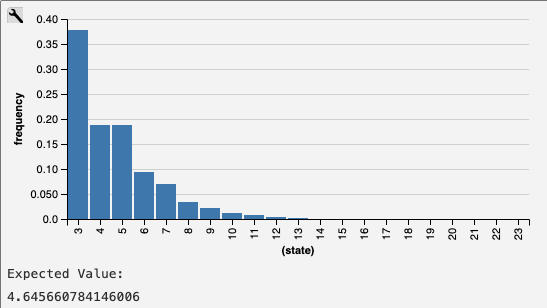
        83700377-a2e9-41ae-b8ef-d11e9c1a079b-image.png

        The model I used was this. You can just copy&paste it to http://webppl.org/ and play around with it, if you want to get an impression of what probabilistic programming is.

        var oddrun = function() {
          var fluntil = function() {
            flip(.5) ? fluntil() + 1 : 1
          }
          var flodd = function() {
            if (flip(.5)) {
              return { success : false , l : 1} 
            } else { 
              var r = flodd();
              return { success : !(r.success), l : r.l+1 } ;
            }
          }
          var run = function() {
            var r = flodd()
            return r.success ? r.l : r.l + run()
          };
          var l = fluntil()
          return l + run()
        }
        var dist = Infer(
          {method: 'enumerate', maxExecutions: 50000},
          oddrun);
        
        viz.auto(dist);
        display("Expected Value:")
        display(expectation(dist))


        :::

        jon-nycJ 1 Reply Last reply
        • KlausK Klaus

          :::
          You didn't specify that the solution must be analytic, so...

          Just for the heck of it, I thought this might be a good excuse to play around with WebPPL.

          This is the distribution and expected value I got.

          83700377-a2e9-41ae-b8ef-d11e9c1a079b-image.png

          The model I used was this. You can just copy&paste it to http://webppl.org/ and play around with it, if you want to get an impression of what probabilistic programming is.

          var oddrun = function() {
            var fluntil = function() {
              flip(.5) ? fluntil() + 1 : 1
            }
            var flodd = function() {
              if (flip(.5)) {
                return { success : false , l : 1} 
              } else { 
                var r = flodd();
                return { success : !(r.success), l : r.l+1 } ;
              }
            }
            var run = function() {
              var r = flodd()
              return r.success ? r.l : r.l + run()
            };
            var l = fluntil()
            return l + run()
          }
          var dist = Infer(
            {method: 'enumerate', maxExecutions: 50000},
            oddrun);
          
          viz.auto(dist);
          display("Expected Value:")
          display(expectation(dist))


          :::

          jon-nycJ Online
          jon-nycJ Online
          jon-nyc
          wrote on last edited by jon-nyc
          #4

          @klaus

          I haven’t solved it yet but that seems too low.

          The only sequences with less than 5 flips satisfying our conditions are:

          THT
          TTHT
          HTHT

          Unless I’m calculating wrong probability of getting any of these three is 1/4

          Person. Woman. Man. Camera. TV.

          1 Reply Last reply
          • KlausK Offline
            KlausK Offline
            Klaus
            wrote on last edited by Klaus
            #5

            Oh right, I think there was a missing plus sign in my model, which I've now fixed.

            This is what I get now.

            :::
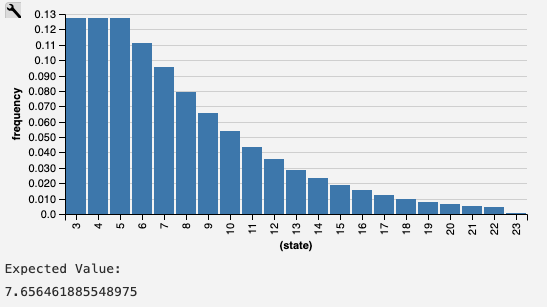
            c152e092-c28c-491e-a0be-7b1cd7175a6c-image.png

            This looks right to me. The probability of THT is 1/8. The probability of TTHT or HTHT is 1/16, with a combined probability of 1/8.

            My take for an analytic solution would be to count how many "winning" sequences of length n there are (let's call this q(n)) and then compute the limit of the sum of all i*q(i) / (2^i)
            (for i = 1 to infinity) to get the expected value. Obviously, q(1)=0, q(2) = 0, q(3) = 1 and q(4) = 2. From the distribution diagram above I infer q(5) = 4 and q(6) = 7.

            This looks suspiciously similar to the Fibonacci sequence minus one.

            :::

            1 Reply Last reply
            • KlausK Offline
              KlausK Offline
              Klaus
              wrote on last edited by Klaus
              #6

              :::

              That's the limit of the sum of all i*(Fib(i)-1) / (2^i). The main insight is that the number of "winning" sequences of length i is Fib(i)-1.

              I don't really have an argument why it needs to be Fib(i)-1 (except the "abductive reasoning" rationale above), but I'm pretty confident that it is correct.
              :::

              1 Reply Last reply
              • jon-nycJ Online
                jon-nycJ Online
                jon-nyc
                wrote on last edited by
                #7

                I got the same answer both by grinding it out and with a cute solution that I’ll share later.

                Person. Woman. Man. Camera. TV.

                1 Reply Last reply
                • KlausK Offline
                  KlausK Offline
                  Klaus
                  wrote on last edited by
                  #8

                  With a small change in the task it should be possible to construct it in such a way that the average number of flips is infinite.

                  1 Reply Last reply

                  Hello! It looks like you're interested in this conversation, but you don't have an account yet.

                  Getting fed up of having to scroll through the same posts each visit? When you register for an account, you'll always come back to exactly where you were before, and choose to be notified of new replies (either via email, or push notification). You'll also be able to save bookmarks and upvote posts to show your appreciation to other community members.

                  With your input, this post could be even better 💗

                  Register Login
                  Reply
                  • Reply as topic
                  Log in to reply
                  • Oldest to Newest
                  • Newest to Oldest
                  • Most Votes


                  • Login

                  • Don't have an account? Register

                  • Login or register to search.
                  • First post
                    Last post
                  0
                  • Categories
                  • Recent
                  • Tags
                  • Popular
                  • Users
                  • Groups