The AI bubble is still ahead of us
-
I’ve read some interesting perspectives on why it isn’t in a bubble, both looking at PE ratios (much lower than in the dot com era) and the fact that the infrastructure companies aren’t building ahead of demand (like Cisco and the telecoms did in the dot com era). No one is laying the equivalent of dark fiber. Every gpu nvidia makes gets lit up right away.
Gavin Baker’s fund is interesting- he owns all these AI stocks but has a huge short position in QQQ as a hedge.
Complicated hedging strategies don't make much sense to me. If you want to be both long and short highly correlated equities in order to insure the primary bet, maybe just discard the insurance and invest a reduced amount of capital in the primary bet. But if you want to potentially profit on a massive reverse move, I guess you'd have to do something more complicated.
I’ve read some interesting perspectives on why it isn’t in a bubble, both looking at PE ratios (much lower than in the dot com era) and the fact that the infrastructure companies aren’t building ahead of demand (like Cisco and the telecoms did in the dot com era). No one is laying the equivalent of dark fiber. Every gpu nvidia makes gets lit up right away.
Gavin Baker’s fund is interesting- he owns all these AI stocks but has a huge short position in QQQ as a hedge.
Complicated hedging strategies don't make much sense to me. If you want to be both long and short highly correlated equities in order to insure the primary bet, maybe just discard the insurance and invest a reduced amount of capital in the primary bet. But if you want to potentially profit on a massive reverse move, I guess you'd have to do something more complicated.
The short gives you a lot more money to invest. You’re betting that the AI companies will compose a larger and larger percentage of the tech stock universe, which could pay off regardless of what happens to the overall market. It’s actually how hedge funds got their name.
There will be no deal with Iran except UNCONDITIONAL SURRENDER. -DJT, 3/6/26
-
I’ve read some interesting perspectives on why it isn’t in a bubble, both looking at PE ratios (much lower than in the dot com era) and the fact that the infrastructure companies aren’t building ahead of demand (like Cisco and the telecoms did in the dot com era). No one is laying the equivalent of dark fiber. Every gpu nvidia makes gets lit up right away.
Gavin Baker’s fund is interesting- he owns all these AI stocks but has a huge short position in QQQ as a hedge.
Complicated hedging strategies don't make much sense to me. If you want to be both long and short highly correlated equities in order to insure the primary bet, maybe just discard the insurance and invest a reduced amount of capital in the primary bet. But if you want to potentially profit on a massive reverse move, I guess you'd have to do something more complicated.
The short gives you a lot more money to invest. You’re betting that the AI companies will compose a larger and larger percentage of the tech stock universe, which could pay off regardless of what happens to the overall market. It’s actually how hedge funds got their name.
I’ve read some interesting perspectives on why it isn’t in a bubble, both looking at PE ratios (much lower than in the dot com era) and the fact that the infrastructure companies aren’t building ahead of demand (like Cisco and the telecoms did in the dot com era). No one is laying the equivalent of dark fiber. Every gpu nvidia makes gets lit up right away.
Gavin Baker’s fund is interesting- he owns all these AI stocks but has a huge short position in QQQ as a hedge.
Complicated hedging strategies don't make much sense to me. If you want to be both long and short highly correlated equities in order to insure the primary bet, maybe just discard the insurance and invest a reduced amount of capital in the primary bet. But if you want to potentially profit on a massive reverse move, I guess you'd have to do something more complicated.
The short gives you a lot more money to invest. You’re betting that the AI companies will compose a larger and larger percentage of the tech stock universe, which could pay off regardless of what happens to the overall market. It’s actually how hedge funds got their name.
I had ChatGPT explain it to me. The reason I was confused is that it's not really an insured long on the AI stocks. It's a pairs trade where the investor is betting the AI stocks will outperform the broader QQQ, regardless of the overall direction of either. I guess that's a "hedge" by some other definition than the one I'm familiar with. I know it as a pairs trade, or arbitrage.
-
NVidia CEO reminds the world that large portions of the masses are insane:
"Remember last year when we were together, the rhetoric and the narrative around the investment were, 'What's the ROI?'" he added. "Give me one example of some crazy person saying that now. They're going to sound insane."
This notion that AI has no ROI is still abundant in online stock discussions. Lots of people can't disentangle their hatred of a new technology from a sober assessment of its economic potential.
-
There's also abundant breath-holding from people in computer game discussions about how they'll never purchase a game that used AI in its development. It's interesting watching a social movement that is so obviously a flash in the pan, participated in by people who are only telling on themselves that they're afraid of change, and prefer to scream at the clouds rather than accept it.
-
There's also abundant breath-holding from people in computer game discussions about how they'll never purchase a game that used AI in its development. It's interesting watching a social movement that is so obviously a flash in the pan, participated in by people who are only telling on themselves that they're afraid of change, and prefer to scream at the clouds rather than accept it.
There's also abundant breath-holding from people in computer game discussions about how they'll never purchase a game that used AI in its development.
If the cost of video cards and memory continue to rise, they may not be able to afford to play it.
I was only joking
-
Is necessary to have high resolution video playing at a high frame rate to enjoy computer games?
Beyond 30 frames per second, is there a practical difference other than bragging rights?
-
Is necessary to have high resolution video playing at a high frame rate to enjoy computer games?
Beyond 30 frames per second, is there a practical difference other than bragging rights?
-
There's also abundant breath-holding from people in computer game discussions about how they'll never purchase a game that used AI in its development.
If the cost of video cards and memory continue to rise, they may not be able to afford to play it.
They need to invest in chip stocks.
-
Is necessary to have high resolution video playing at a high frame rate to enjoy computer games?
Beyond 30 frames per second, is there a practical difference other than bragging rights?
Is necessary to have high resolution video playing at a high frame rate to enjoy computer games?
Most of the games I play have intentionally retro graphics, ostensibly for aesthetic reasons, but really because the small indie creators can't draw and can't afford artwork. AI will be a positive difference there IMO.
-
-
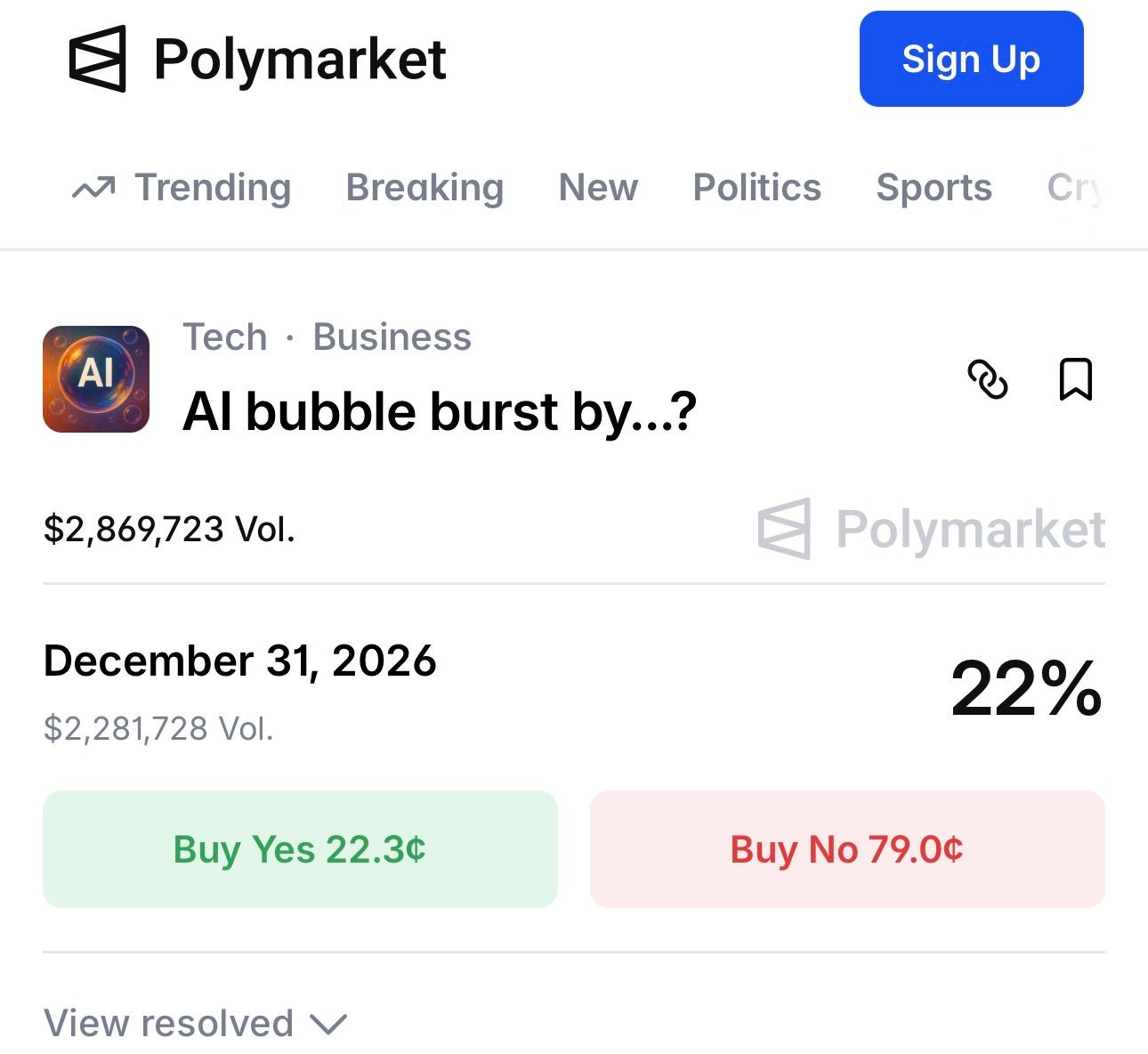
Fine print pasted below. Seems to me that exogenous macro stuff is the most likely cause of these things. If China does something to Taiwan it'll come true, but that has little to do with whether AI is bubbly. I wonder what portion of the credence given to this bubble burst is accounted for by factors beyond AI. With only 23% credence to account for, there may not be much credence left over to assign to value-based reasons for a bubble burst.
Not sure how to see when that prediction market opened, but I think it goes back to at least November 2025. The stocks in question have done extraordinary things in that time. If we do see this 50% pullback, many will still be up from their Nov '25 price. Not NVDA, but lots of others.
For the purposes of this market, the AI industry will be considered to have experienced an industry downturn once at least three of the following events have occurred within 90 days of this market's specified timeframe:
- NVIDIA Corporation (NVDA) closing stock price is down 50% from its all-time high.
- iShares PHLX Semiconductor ETF (SOXX) closing stock price is down 40% from its all-time high.
- OpenAI, Inc. or Anthropic PBC declares bankruptcy.
- OpenAI, Inc. is acquired.
- H100 rental price falls to $1.00 or lower for five consecutive days, as shown on the SiliconData Silicon Index at:
https://www.silicondata.com/products/silicon-index. - Major AI Hardware Supplier Collapse: Taiwan Semiconductor Manufacturing Company Limited (TSM), ASML Holding N.V. (ASML), Broadcom Inc. (AVGO), Arista Networks, Inc. (ANET), or Super Micro Computer, Inc. (SMCI), closing stock price is down 50% from its all-time high.
-
Looked it up and the ETF mentioned, SOXX, has gone from 270 to over 600 in the time that bet has been live.
So if someone bet on this bubble burst in polymarket when that bet opened, and at the same time shorted SOXX, and if this 40% drop occurs within the specified time, they will have won the polymarket bet, and yet their short will have lost money.
For the careful "yes" gamblers who placed bets when the bet opened, I assume they realized that if the "bubble" kept inflating, (as it has,) it's not necessarily bad for their bet, until they run out of time for the burst. "Sometime within the next 14 months, stock x will be 50% down from its all time high" is a very different proposition from "Sometime within the next 14 months, x will be down 50% from where it's at today".
-
Gambling is the root of all evil they say. I got better things to do with the rest of my life than to psychoanalyze the future of gambling. Maybe that’s because I have a fucking pension ha ha ha ha when does a man feel enough is enough? So glad I am not afflicted with greed. Face it, none of you need it, but it takes up a big chunk of your life.
-
Look at the government pension teat suckler making fun of other people for being concerned about money. That's rich. But I have to hand it to you, it's a great scam to suck taxpayer dollars out of people you hate, from a country you hate.
I guess I could put my investment capital into T bills and forget about it for the rest of my life, and I'd still definitely be better off than you, but that would be no fun.
-
Look at the government pension teat suckler making fun of other people for being concerned about money. That's rich. But I have to hand it to you, it's a great scam to suck taxpayer dollars out of people you hate, from a country you hate.
I guess I could put my investment capital into T bills and forget about it for the rest of my life, and I'd still definitely be better off than you, but that would be no fun.
Look at the government pension teat suckler making fun of other people for being concerned about money. That's rich. But I have to hand it to you, it's a great scam to suck taxpayer dollars out of people you hate, from a country you hate.
I guess I could put my investment capital into T bills and forget about it for the rest of my life, and I'd still definitely be better off than you, but that would be no fun.
I would have bet the farm if I was a gambling man that one member of this form would be triggered and spew his vitriol here. Maybe I should take up gambling just for the fun of it.
-
Look at the government pension teat suckler making fun of other people for being concerned about money. That's rich. But I have to hand it to you, it's a great scam to suck taxpayer dollars out of people you hate, from a country you hate.
I guess I could put my investment capital into T bills and forget about it for the rest of my life, and I'd still definitely be better off than you, but that would be no fun.
I would have bet the farm if I was a gambling man that one member of this form would be triggered and spew his vitriol here. Maybe I should take up gambling just for the fun of it.
Look at the government pension teat suckler making fun of other people for being concerned about money. That's rich. But I have to hand it to you, it's a great scam to suck taxpayer dollars out of people you hate, from a country you hate.
I guess I could put my investment capital into T bills and forget about it for the rest of my life, and I'd still definitely be better off than you, but that would be no fun.
I would have bet the farm if I was a gambling man that one member of this form would be triggered and spew his vitriol here. Maybe I should take up gambling just for the fun of it.
Well since you've threatened to kill me before, in one of your psychotic episodes that you probably don't even remember since you're now medicated, I have lifetime license to treat you like the abject piece of shit that you actually are. Enjoy, little man.




Hello! It looks like you're interested in this conversation, but you don't have an account yet.
Getting fed up of having to scroll through the same posts each visit? When you register for an account, you'll always come back to exactly where you were before, and choose to be notified of new replies (either via email, or push notification). You'll also be able to save bookmarks and upvote posts to show your appreciation to other community members.
With your input, this post could be even better 💗
Register Login