Skip to content
  • Categories
  • Recent
  • Tags
  • Popular
  • Users
  • Groups
Skins
  • Light
  • Brite
  • Cerulean
  • Cosmo
  • Flatly
  • Journal
  • Litera
  • Lumen
  • Lux
  • Materia
  • Minty
  • Morph
  • Pulse
  • Sandstone
  • Simplex
  • Sketchy
  • Spacelab
  • United
  • Yeti
  • Zephyr
  • Dark
  • Cyborg
  • Darkly
  • Quartz
  • Slate
  • Solar
  • Superhero
  • Vapor

  • Default (No Skin)
  • No Skin
Collapse

The New Coffee Room

  1. TNCR
  2. General Discussion
  3. "When you find a fork in the road...
"When you find a fork in the road...

Scheduled Pinned Locked Moved General Discussion
5 Posts 4 Posters 44 Views
  • Oldest to Newest
  • Newest to Oldest
  • Most Votes
Reply
  • Reply as topic
Log in to reply
This topic has been deleted. Only users with topic management privileges can see it.
  • George KG Offline
    George KG Offline
    George K
    wrote on last edited by
    #1

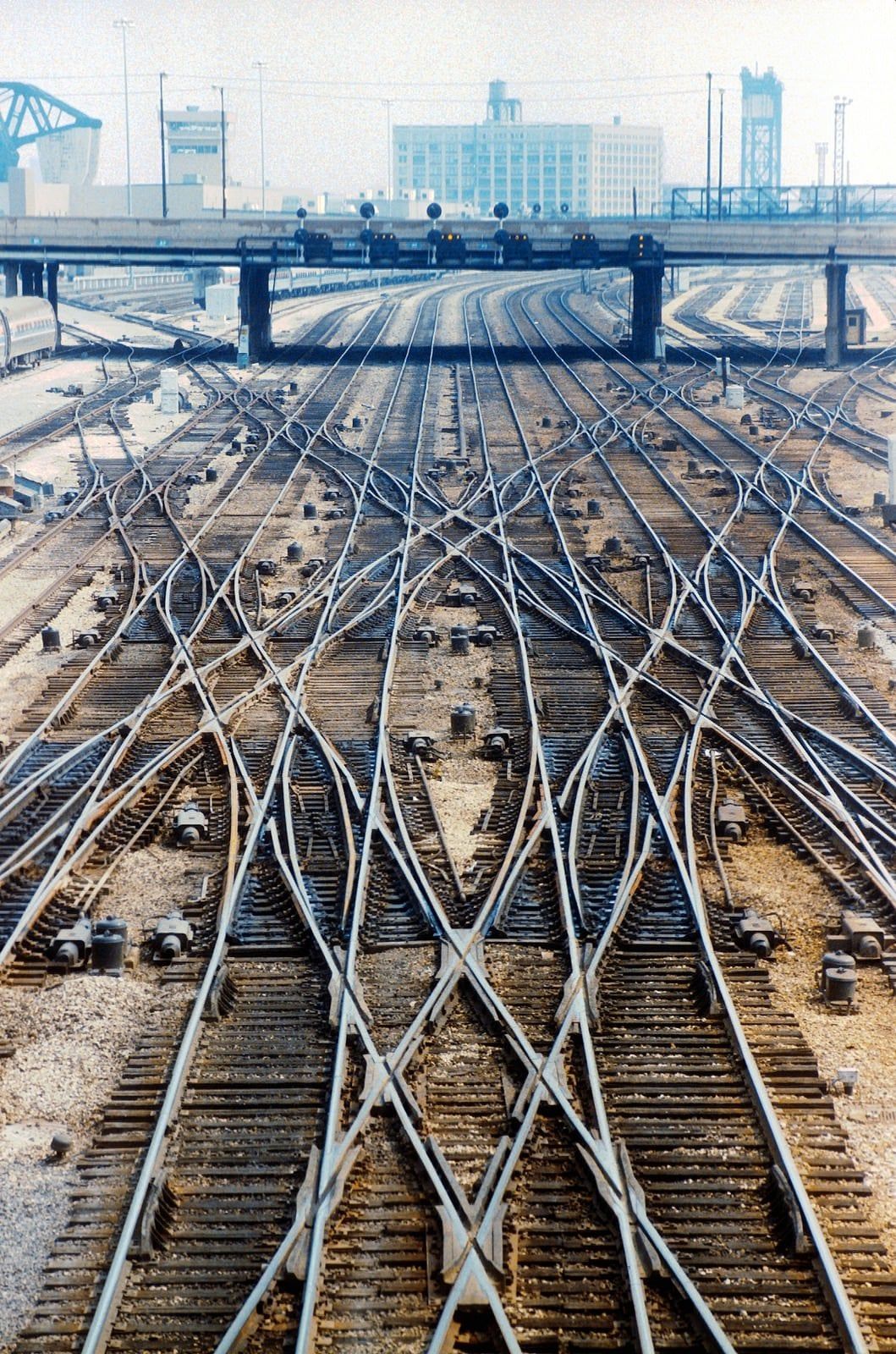
    ...take it."

    471818512_931504595751364_6250573881597091037_n.jpg

    Leaving Union Station in Chicago.

    "Now look here, you Baltic gas passer... " - Mik, 6/14/08

    The saying, "Lite is just one damn thing after another," is a gross understatement. The damn things overlap.

    1 Reply Last reply
    • AxtremusA Offline
      AxtremusA Offline
      Axtremus
      wrote on last edited by
      #2

      Interesting. Wonder if there are a maximum and a minimum turning radii that trains and train tracks must design within.

      George KG 1 Reply Last reply
      • CopperC Offline
        CopperC Offline
        Copper
        wrote on last edited by
        #3

        Min radius zero

        image.png

        1 Reply Last reply
        • jon-nycJ Offline
          jon-nycJ Offline
          jon-nyc
          wrote on last edited by jon-nyc
          #4

          lol @Copper

          But @Axtremus of course there is. The wheels have to stay on the tracks after all. You could calculate the minimum turning radius if you knew the track guage and a few measurements on the wheel set

          The whole reason we call them illegal aliens is because they’re subject to our laws.

          1 Reply Last reply
          • AxtremusA Axtremus

            Interesting. Wonder if there are a maximum and a minimum turning radii that trains and train tracks must design within.

            George KG Offline
            George KG Offline
            George K
            wrote on last edited by
            #5

            @Axtremus said in "When you find a fork in the road...:

            Interesting. Wonder if there are a maximum and a minimum turning radii that trains and train tracks must design within.

            General Guidelines:
            1. High-Speed Rail:
            • Radius: 3,500 to 7,000 meters (11,500 to 23,000 feet) or more.
            • Reason: High-speed trains require gentle curves to maintain stability and passenger comfort.
            2. Conventional Passenger Trains:
            • Radius: 400 to 1,200 meters (1,300 to 3,900 feet).
            • Reason: Balances speed and track construction constraints.
            3. Freight Trains:
            • Radius: 150 to 400 meters (500 to 1,300 feet), depending on the train’s length and load.
            • Reason: Freight trains can handle tighter curves at lower speeds but require more lateral clearance due to longer cars.
            4. Urban and Light Rail:
            • Radius: 15 to 100 meters (50 to 330 feet).
            • Reason: Tight curves are common in urban areas to navigate city streets or tunnels.

            Factors Influencing Minimum Radius:
            1. Speed: Higher speeds require larger radii to reduce lateral forces and ensure passenger comfort.
            2. Superelevation: Banking the track (superelevation) allows for smaller radii at moderate speeds.
            3. Train Length and Type: Longer trains need larger radii to prevent derailment or excessive wheel-rail wear.
            4. Track Purpose: Freight tracks prioritize cargo capacity, while urban systems prioritize space efficiency.

            Engineering Examples:
            • Japan’s Shinkansen (High-Speed Rail): Typically uses curve radii of 4,000 meters (13,000 feet) or more.
            • European Rail Standards (UIC): Suggest a minimum radius of 150 meters (490 feet) for low-speed tracks and 3,500 meters (11,500 feet) for high-speed rail.
            • Tight Urban Curves: Light rail systems, like trams, often use radii as small as 15 meters (50 feet) in city environments.


            "Now look here, you Baltic gas passer... " - Mik, 6/14/08

            The saying, "Lite is just one damn thing after another," is a gross understatement. The damn things overlap.

            1 Reply Last reply

            Hello! It looks like you're interested in this conversation, but you don't have an account yet.

            Getting fed up of having to scroll through the same posts each visit? When you register for an account, you'll always come back to exactly where you were before, and choose to be notified of new replies (either via email, or push notification). You'll also be able to save bookmarks and upvote posts to show your appreciation to other community members.

            With your input, this post could be even better 💗

            Register Login
            Reply
            • Reply as topic
            Log in to reply
            • Oldest to Newest
            • Newest to Oldest
            • Most Votes


            • Login

            • Don't have an account? Register

            • Login or register to search.
            • First post
              Last post
            0
            • Categories
            • Recent
            • Tags
            • Popular
            • Users
            • Groups