Mildly interesting
-
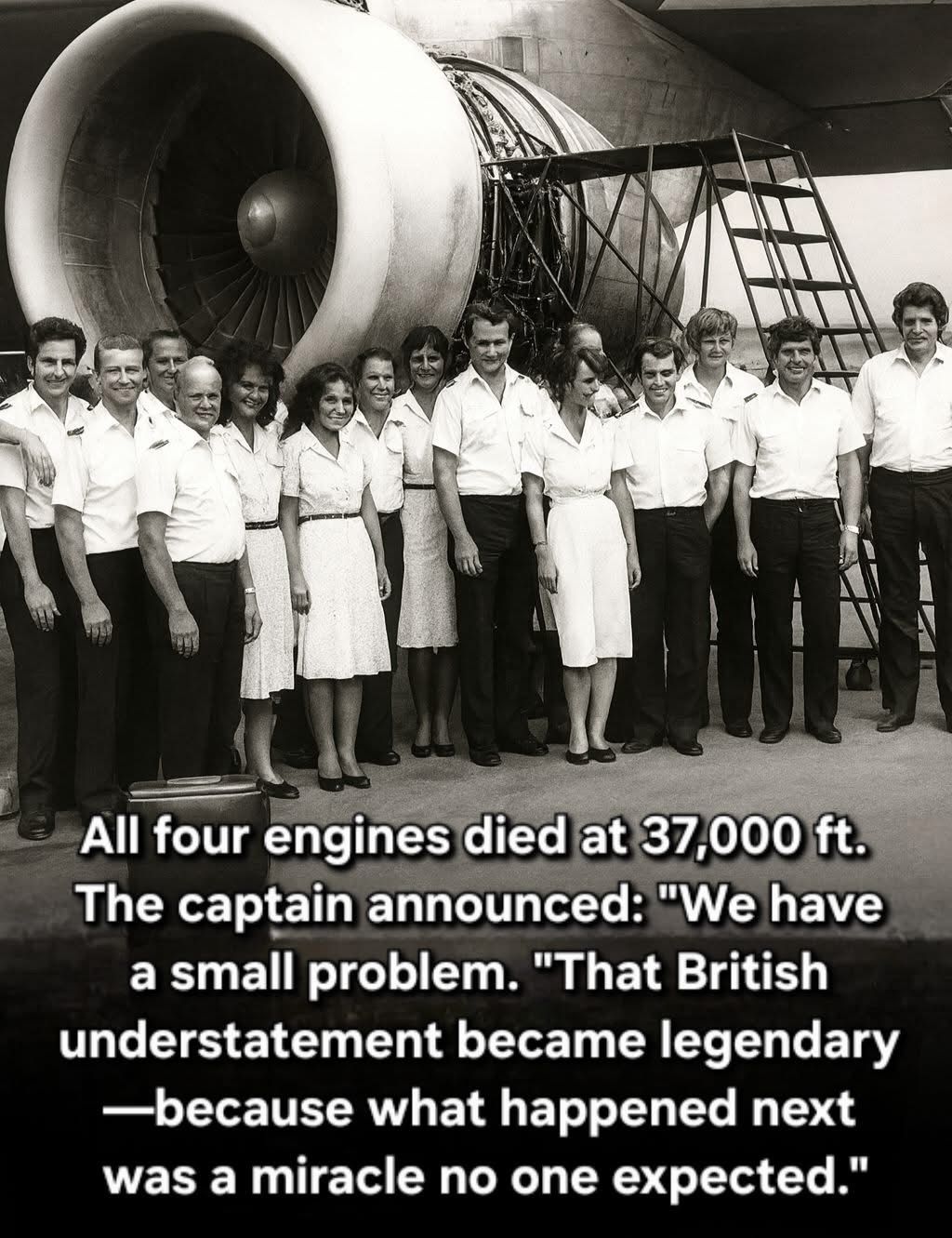
June 24, 1982. Over the Indian Ocean.
British Airways Flight 9—a Boeing 747 carrying 263 people—was cruising peacefully at 37,000 feet when the night sky began behaving strangely.
First came St. Elmo’s fire—an eerie blue glow crackling across the cockpit windows like electricity dancing on glass.
Then shimmering streaks appeared along the wings, as if the aircraft were trailing sparks through darkness.
Captain Eric Moody and his crew had never seen anything like it. Beautiful. Unsettling. Wrong.
Then came the engine failure alarm.
Engine four had failed.
Before they could process that, engine two quit.
Then engine one.
Then engine three.
In less than 90 seconds, all four engines on British Airways Flight 9 had stopped.
Complete. Total. Silence.
At 37,000 feet.
The Impossible Problem
A commercial jet losing one engine is manageable—they're designed to fly on three, or even two.
Losing two engines is a serious emergency requiring immediate landing.
Losing three engines is catastrophic but theoretically survivable.
Losing all four? That’s not supposed to happen. Ever.
Yet here was Captain Moody, flying a 300-ton glider with 263 souls aboard, no engines, no power, and no idea why.
The 747 was descending—13,000 feet lost in 23 minutes—and below them was the Indian Ocean and the mountainous Indonesian coastline.
They had minutes to figure out what had happened and somehow restart the engines before the aircraft became unflyable.
“Ladies and Gentlemen…”
In the cabin, passengers saw sparks outside their windows. Oxygen masks dropped. The cabin filled with acrid smoke that smelled like sulfur.
People began writing farewell notes to loved ones.
Then Captain Moody’s voice came over the intercom—calm, almost casual, with classic British understatement:
“Ladies and gentlemen, this is your captain speaking. We have a small problem. All four engines have stopped. We are doing our damnedest to get them going again. I trust you are not in too much distress.”
A small problem.
All four engines stopped.
That announcement would become one of the most famous in aviation history—not just for its legendary understatement, but because what followed was even more remarkable.
Fighting for Survival
In the cockpit, controlled chaos.
Co-pilot Roger Greaves’ oxygen mask had broken, leaving him gasping for breath. Moody immediately descended—trading precious altitude for breathable air to save his co-pilot.
Flight Engineer Barry Townley-Freeman worked frantically through restart procedures while Senior First Officer Barry Fremantle handled communications with Jakarta ATC.
They tried restarting the engines.
Nothing.
Again.
Nothing.
They tried different procedures, different combinations, everything in the manual and things that weren’t.
Ten attempts. Twelve. Fifteen.
Each failure meant less altitude, less time, less chance of survival.
The aircraft descended through 15,000 feet. Then 14,000. Then 13,000.
At some point, they’d be too low to restart safely even if the engines came back.
They were running out of sky.
The Miracle
At 13,500 feet—with Jakarta’s mountainous terrain looming in darkness—engine four suddenly coughed, sputtered, and roared back to life.
Then engine three caught.
Then engine one.
Finally, engine two.
All four engines, dead for 13 minutes and 13,000 feet of descent, had somehow restarted.
The relief in the cockpit was overwhelming. They had power. They had control. They could fly again.
But they weren’t safe yet.
Flying Blind
The volcanic ash that had choked the engines had also sandblasted the cockpit windscreen.
The windows weren’t just dirty—they were opaque, abraded by millions of tiny ash particles traveling at 500 mph.
Captain Moody could barely see through them. Landing would require threading the aircraft through Jakarta’s airspace, lining up with a runway, and touching down—while essentially flying blind.
They used side windows for glimpses. They relied heavily on instruments. They followed radio guidance from Jakarta approach.
Somehow, impossibly, Moody brought the crippled 747 down safely at Halim Perdanakusuma Airport.
Not a single person died.
All 263 passengers and crew walked away.
The Invisible Enemy
Only after landing did investigators discover what had happened:
Mount Galunggung had been erupting for months. On June 24, 1982, it sent a massive ash cloud into the atmosphere—8 miles high, spreading for hundreds of miles.
Flight 9 had flown directly through it.
Volcanic ash is pulverized rock—tiny shards of glass suspended in air. It’s invisible to weather radar and nearly impossible to see at night.
When engines ingest it, the ash melts, coats internal components, and chokes the engines.
The engines restarted only because Moody descended below the ash cloud, where cooler air allowed the melted glass to solidify and break off.
Skill kept them alive long enough for luck to matter.
The Legacy
BA Flight 9 changed aviation forever:
Global volcanic ash detection systems were created
Airlines receive real-time eruption alerts
Flight paths are rerouted around ash
Pilots are trained for ash encounters
The International Airways Volcano Watch was established
Captain Eric Moody
Moody continued flying for British Airways until retirement. He’s remembered for his skill, composure, and the most iconic announcement in aviation history:
“We have a small problem. All four engines have stopped.”
The Lesson
The impossible sometimes happens. Prepare anyway.
Calm leadership saves lives.
Never give up—restart attempt #15 was the one that worked.
Learn from near-disasters so others don’t repeat them.June 24, 1982.
All four engines died at 37,000 feet.
The crew had 13 minutes and 13,000 feet to solve an impossible problem.They couldn’t see the ash cloud.
They couldn’t see the cause.
They couldn’t even see the runway.But they could think.
They could act.
They refused to quit.And 263 people survived because of it.
British Airways Flight 9: the night the sky went dark—and human skill brought everyone home.
-
-

When rescuers first found Beauty, a bald eagle in Alaska, she was barely alive. A single gunshot had destroyed her upper beak, the tool she needed for everything: eating, drinking, grooming, and defending herself. Without it, she was trapped in a slow, inevitable decline. In the wild, she would have survived only a few days.
But a handful of strangers refused to accept that ending.
A wildlife rehabilitator contacted a mechanical engineer. The engineer brought in a dentist. A dentist reached out to a 3D-printing specialist. Piece by piece, a small, unlikely team formed around a single goal: to give a wounded eagle a second chance at life.
They spent months studying Beauty’s injuries, scanning her skull, designing prototypes, and testing materials that were both light enough for flight and strong enough for daily use. Every millimeter mattered. The prosthetic had to match the shape of a beak that no longer existed.
When the final 3D-printed beak was ready, the team attached it with careful precision.
Then, in a room full of people holding their breath, Beauty did something miraculous.
She reached down…
gripped a piece of food…
and fed herself for the first time since the gunshot.Some cried. Others laughed in disbelief. All of them knew they had witnessed a turning point — not just for one eagle, but for the future of wildlife rehabilitation.
Over the following months, another surprise emerged. Protected by the prosthetic, Beauty’s natural beak began to regrow underneath it. The device had not only restored her function — it had given her body the chance to heal.
Beauty became the first bald eagle in history to receive a fully functional, 3D-printed beak.
Her story remains a powerful reminder that when compassion and innovation work together, even the most broken lives can be rebuilt.If one eagle can inspire this level of devotion… imagine what could happen if we offered the same determination to every living being. See less
-

In 564 BC, a Greek fighter won Olympic gold—after he was already dead.
Arrichion of Phigalia was one of ancient Greece’s greatest athletes, a three-time Olympic champion in pankration, the most savage event of the Games. Pankration blended wrestling, boxing, joint-locks, and chokes into a contest with almost no rules—no rounds, no time limits, and no mercy. Victory came only when one fighter submitted or was rendered unable to continue. By the time Arrichion entered the 54th Olympiad, he was already a legend, feared for his endurance and brutal technique. But his final match would push him beyond the limits of human survival.
During the bout, Arrichion’s opponent managed to wrap an arm around his throat and lock his legs around Arrichion’s torso, applying a choke so tight that he began to lose consciousness. Spectators watched as the champion’s body trembled on the sand, his vision fading, his breath slipping away. Yet even as death crept in, Arrichion refused to tap. In a final, desperate motion, he twisted violently and wrenched his opponent’s toe out of its joint. The pain was so blinding that his opponent screamed and signaled surrender. In that same moment, Arrichion went limp—already dead from suffocation.
What followed was unlike anything in Olympic history. Judges declared Arrichion the winner because his opponent had submitted first. His lifeless body was crowned with the olive wreath, carried out of the arena to thunderous celebration. To the Greeks, this wasn’t tragedy but triumph: the ultimate proof of courage, endurance, and devotion to glory. Arrichion became immortal not only as a champion, but as the only athlete ever to win the Olympics from beyond the grave—a testament to a culture that believed true honor was worth any price, even life itself.
-
wrong python character.
more like this guy
-
@jon-nyc Talking about migration...
-

The hole in the roof isn't a mistake. It is the only reason the building is still standing.
When people walk into the Pantheon, they look up at the rain falling through the 9-meter opening and ask: "Did they run out of money? Why didn't they finish the roof?"
The answer is Roman genius.- Why is the hole there? (The Engineering) If the Romans had closed the dome with heavy concrete, the weight at the top would have been too crushing. The dome would have collapsed under its own stress 2,000 years ago. The Oculus (the eye) acts as a "Reverse Keystone." It actually relieves the structural tension. It lightens the load at the weakest point of the dome.
- The Secret Recipe (Why it doesn't collapse) The Romans didn't just pour one type of concrete. They were the masters of chemistry.
At the bottom (the base): They used concrete mixed with heavy Travertine rock for strength.
In the middle: They switched to lighter Tuff rock.
At the very top (near the hole): They mixed the concrete with Pumice (volcanic rock so light it floats on water).
The top of the dome is incredibly light. If they had used the heavy bottom concrete at the top, the Pantheon would be a pile of rubble today. - Why doesn't it flood? It has rained inside the Pantheon for nearly 2,000 years. So why isn't the floor a swimming pool? If you look closely at the marble floor, it isn't flat. It is slightly convex (curved in the center). This guides the rainwater toward 22 tiny, hidden drainage holes cut directly into the marble. The water flows into an ancient Roman sewer system underneath the building—a system that still works today.
- The "Sun" Dial The hole wasn't just for weight; it was for the gods. The Pantheon was a temple to "All Gods." The Oculus allowed the heavens to enter the temple. On April 21st (the birthday of Rome), the sun strikes the entrance grill perfectly at noon. It wasn't just a building; it was a functioning astronomical clock.
So no, they didn't forget the glass. They built a machine made of stone that has survived Barbarians, Popes, and gravity for 19 centuries.