Good news re opioid deaths
-
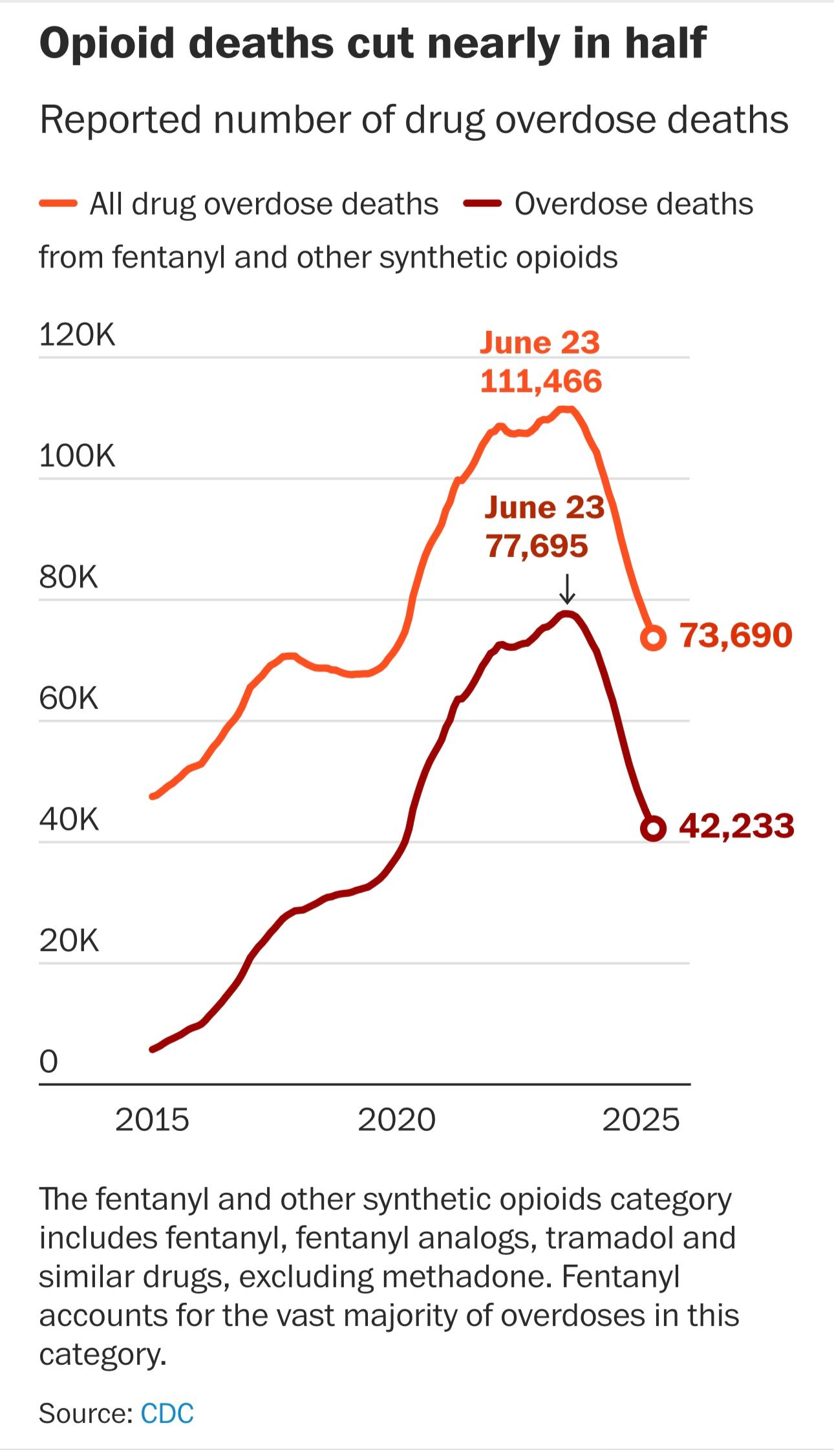
Short answer: there is no single cause. The sharp decline starting in summer 2023 is real, but it reflects several forces hitting at once, some intentional and some accidental.
Here’s the cleanest way to understand it.
⸻
- Naloxone saturation finally crossed a threshold
This is probably the biggest contributor.
By mid-2023:
• Naloxone was OTC, cheap, and everywhere
• Police, EMTs, shelters, libraries, bars, and users themselves had it
• Multiple doses per event became common practiceWhat changed wasn’t naloxone existing — it was ubiquity + speed.
Enough overdoses were reversed before hypoxia became fatal that deaths dropped rapidly.Key point: Naloxone doesn’t reduce overdoses — it reduces fatal overdoses. The curve you’re seeing is deaths, not use.
⸻
- The fentanyl market changed (quietly but decisively)
This is underappreciated.
Evidence from toxicology and drug-checking shows:
• Lower fentanyl purity and variability
• Fewer ultra-potent analogs (e.g., carfentanil spikes)
• More xylazine-adulterated but less acutely lethal mixesWhy?
• Supply chain disruptions
• Shifts in Mexican production and distribution
• Dealers responding to customer death backlash (dead customers don’t buy)The drug supply became more predictable, which paradoxically saves lives.
⸻
- People adapted their behavior
After years of carnage, user behavior changed:
• Test doses
• Never using alone
• Staggered dosing
• Widespread fentanyl test strip useThis is Darwinian harm reduction — brutal, but real.
Once a critical mass of users changes behavior, death rates can fall fast even if addiction rates don’t.
⸻
- Medication-assisted treatment finally scaled
By 2023:
• Buprenorphine prescribing barriers were relaxed
• Methadone access expanded in many states
• Jail/prison initiation programs increasedMAT doesn’t eliminate use — it reduces lethality, especially fentanyl lethality.
Again: fewer deaths, not necessarily fewer users.
⸻
- There is some statistical compression — but not enough to explain this
Yes, there are:
• Reporting lags
• Provisional data effects
• Cause-of-death coding delaysBut:
• The decline is too large and sustained to be an artifact
• Independent datasets show the same inflectionThis isn’t just bookkeeping.
⸻
What this is not
• Not a sudden success of the “war on drugs”
• Not primarily incarceration
• Not abstinence
• Not moral reformIt’s engineering, distribution, and adaptation, not virtue.
⸻
The uncomfortable but accurate summary
Overdose deaths fell not because fewer people use opioids, but because we finally made opioid use less fatal.
That’s why the drop is steep and sudden — once survival probability crosses a threshold, curves bend fast.
If you want, I can:
• Break down which states drove most of the decline
• Explain why deaths from xylazine didn’t rise in parallel
• Or compare this to historical declines in HIV deaths once ART scaled (the pattern is eerily similar)


Hello! It looks like you're interested in this conversation, but you don't have an account yet.
Getting fed up of having to scroll through the same posts each visit? When you register for an account, you'll always come back to exactly where you were before, and choose to be notified of new replies (either via email, or push notification). You'll also be able to save bookmarks and upvote posts to show your appreciation to other community members.
With your input, this post could be even better 💗
Register Login